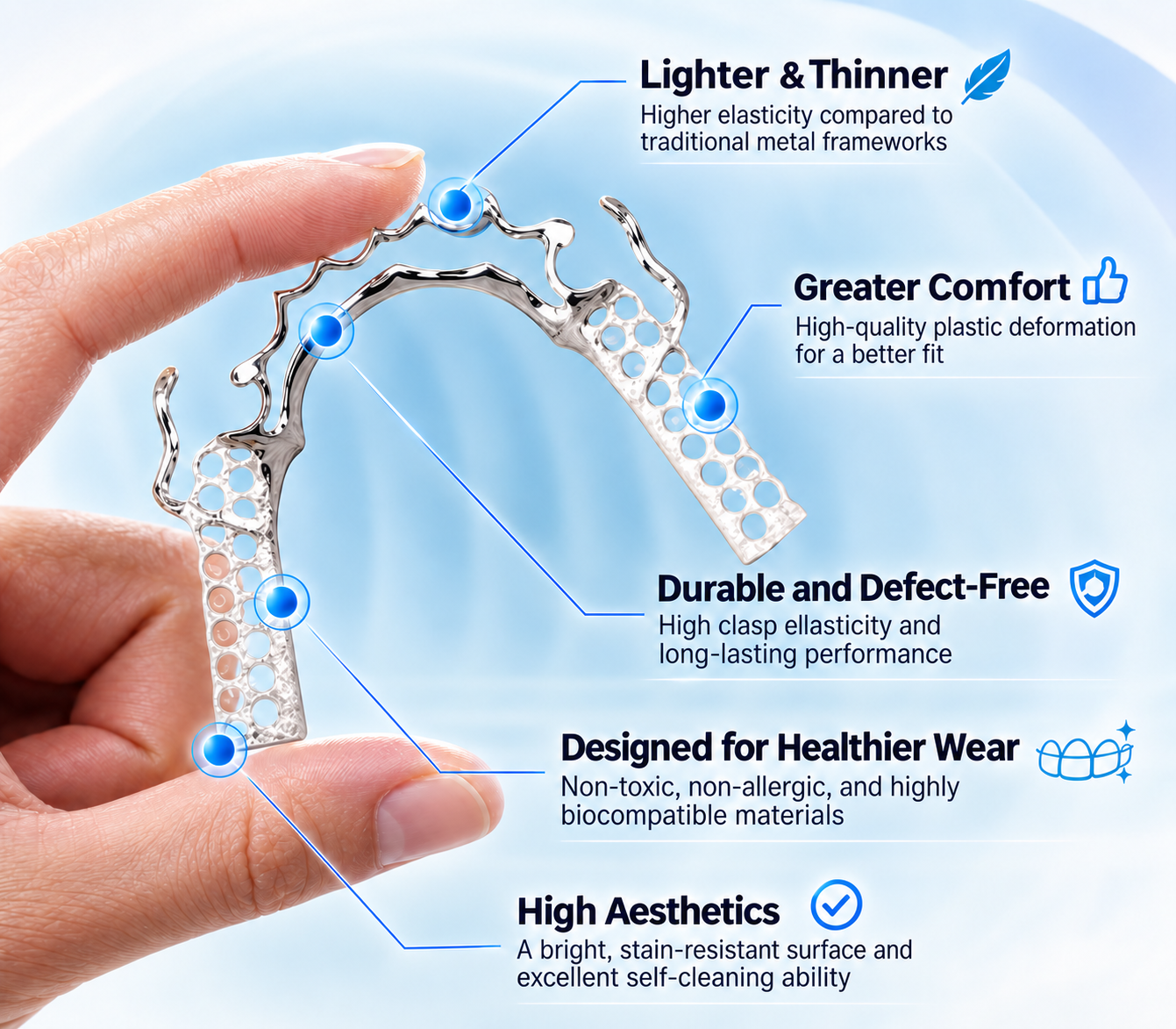
Selective laser melting gives dental labs a more controlled path from digital design to finished framework. The result is a lighter, more precise framework with consistent detail from case to case.
The framework is designed directly from the approved scan, printed in Health-Canada-licensed Mediloy S Co-Cr, and plasma-polished in-house at True North Kromes.
Printed vs. traditional
Compared with traditional casting, the digital workflow reduces variables, removes wax and burnout steps, and makes the production result easier to repeat. Here is the full comparison behind the benefits of printed frameworks.
Cast process
Printed process
Production Efficiency
01
Hand-casted RPD
Low efficiency and slow production.
3D Printed RPD
High efficiency with twice as fast as traditional casting.
Skill & Process
02
Hand-casted RPD
High skill requirement, complex and demanding manufacturing process with a long production cycle.
3D Printed RPD
Low skill requirements and streamlined production process.
Defects & Quality
03
Hand-casted RPD
Poor casting flow that is prone to defects such as sand inclusions and air pockets, and susceptible to breakage.
3D Printed RPD
No casting steps, free from sand inclusions and air pockets, excellent plasticity, and elasticity.
Precision & Fit
04
Hand-casted RPD
Low precision, easily misaligned with low fit accuracy.
3D Printed RPD
High precision, capable of intricate and precise structures with high fit accuracy.
Weight & Design
05
Hand-casted RPD
Thicker profile and the thickness exceeding 0.6mm.
3D Printed RPD
Lightweight and thin with wall thickness as low as 0.3mm.
Environmental Impact
06
Hand-casted RPD
Material wastage, significant waste and environmental pollution.
3D Printed RPD
Material conservation and environmentally friendly.
Biocompatibility
07
Hand-casted RPD
High release of casting metal ions and relatively poor biocompatibility.
3D Printed RPD
Highly compatible with biological systems.
Criteria
Hand-casted RPD
3D Printed RPD
Production Efficiency
Low efficiency and slow production.
High efficiency with twice as fast as traditional casting.
Skill & Process
High skill requirement, complex and demanding manufacturing process with a long production cycle.
Low skill requirements and streamlined production process.
Defects & Quality
Poor casting flow that is prone to defects such as sand inclusions and air pockets, and susceptible to breakage.
No casting steps, free from sand inclusions and air pockets, excellent plasticity, and elasticity.
Precision & Fit
Low precision, easily misaligned with low fit accuracy.
High precision, capable of intricate and precise structures with high fit accuracy.
Weight & Design
Thicker profile and the thickness exceeding 0.6mm.
Lightweight and thin with wall thickness as low as 0.3mm.
Environmental Impact
Material wastage, significant waste and environmental pollution.
Material conservation and environmentally friendly.
Biocompatibility
High release of casting metal ions and relatively poor biocompatibility.
Highly compatible with biological systems.
Interested in Learning More?
Contact us to discuss how we can help streamline your workflow.